AI Applications
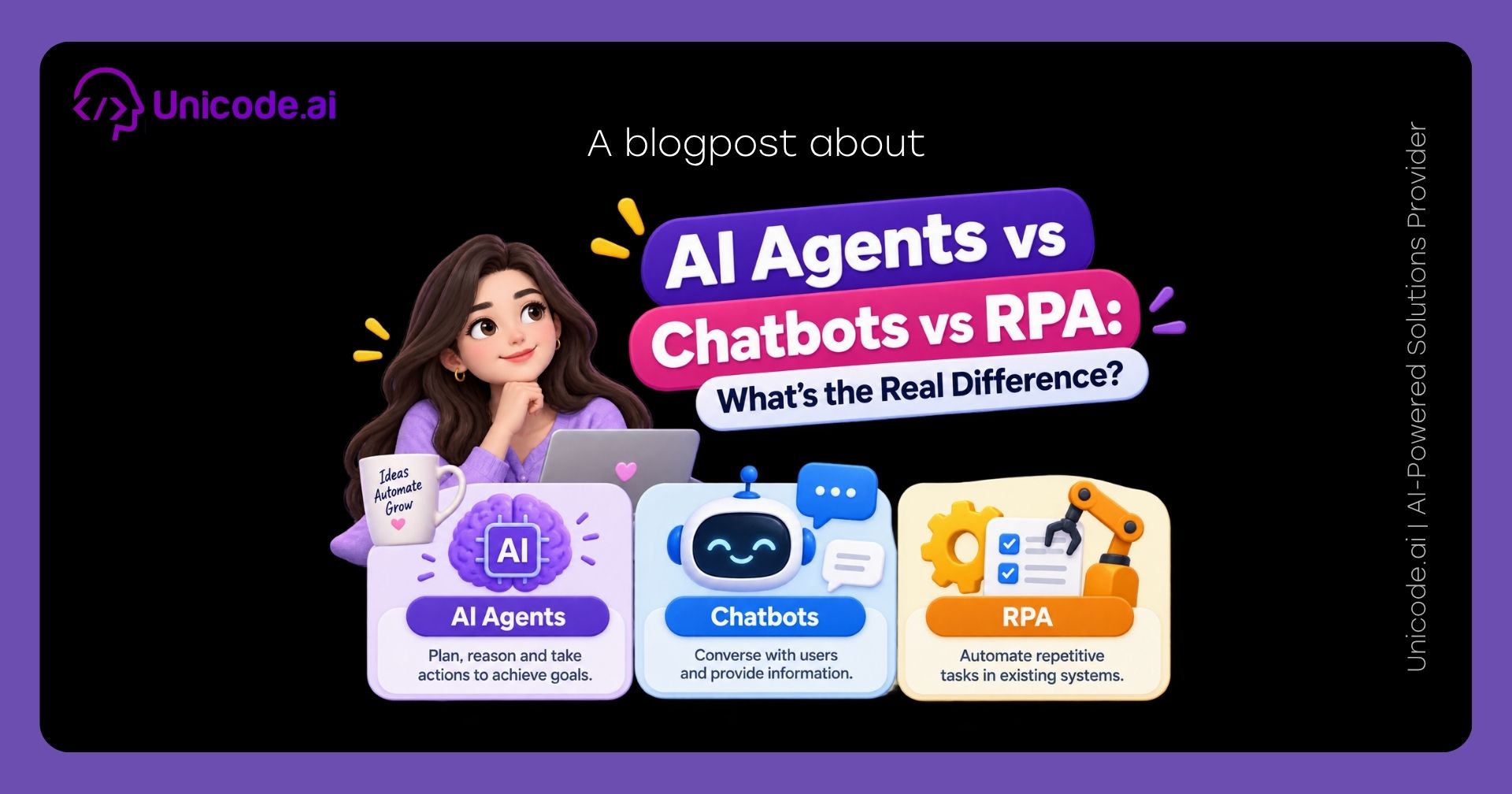
AI Agents vs Chatbots vs RPA: What's the Real Difference?
Introduction
Vendors are happy to call almost anything "AI automation" right now, which makes it genuinely hard to tell whether you need a chatbot, an RPA bot, or an AI agent for a given problem. They're not interchangeable, and picking the wrong one usually shows up later as a project that technically works but never should have been built that way. This guide draws the real line between all three, using how the vendors who build each category actually define the differences.
TL;DR
Chatbots respond to what a user types, RPA executes fixed, rule-based steps without reasoning, and AI agents pursue a goal autonomously, adapting their plan when something doesn't go as expected. The practical difference is reactive versus rule-bound versus adaptive — and in most real deployments, these three work together rather than replacing each other.
Key Facts
- The global AI agents market was valued at $7.6 billion in 2025 and is projected to reach $10.9 billion in 2026, growing at a 49.6% CAGR through 2033 — roughly 1.7x the growth rate of the RPA market over the same period (Grand View Research, 2026).
- The global RPA market was valued at $4.7 billion in 2025 and is projected to reach $6.0 billion in 2026, growing at a 29.0% CAGR through 2033 (Grand View Research, 2026).
- UiPath, one of the largest RPA vendors, explicitly frames RPA and AI agents as complementary rather than competing: "Agents handle sophisticated problem solving and adaptation; RPA ensures reliable execution across enterprise systems; and people provide oversight" (UiPath, 2026).
- Salesforce draws the agent-vs-chatbot line on reactivity: a chatbot "waits for a prompt and responds," while an agent "can monitor an environment... identify a goal... and initiate a multi-step workflow without being prompted" (Salesforce, 2026).
The One-Sentence Difference Between All Three
A chatbot answers what you ask it. RPA does exactly what it was configured to do, the same way, every time. An AI agent pursues a goal you gave it, and changes its approach if the first plan doesn't work. That's the core distinction underneath all the marketing language — reactive, rule-bound, and adaptive, respectively.
Chatbots: Reactive, Conversational, Bounded
A chatbot exists to hold a conversation — answering a question, walking through a scripted flow, or retrieving an answer from a knowledge base — and it does that within a single exchange or a short back-and-forth. It's reactive by design: nothing happens until a user sends a message, and it doesn't pursue objectives on its own between messages.
This makes chatbots the right fit for high-volume, conversational, bounded interactions — customer support FAQs, basic troubleshooting, lead qualification — where the goal is answering well, not executing a multi-step business process autonomously.
RPA: Reliable Execution, Zero Reasoning
RPA automates a fixed sequence of rule-based steps — clicking through a system, copying data between two applications, processing a transaction — exactly the way it was configured, with no judgment involved. UiPath's own description is direct: RPA "mimics human actions in interacting with screens and systems," and it's valued specifically because it does this predictably and securely at scale.
The tradeoff is equally direct: RPA has no reasoning layer. If the underlying process changes — a UI element moves, a new exception case appears — the bot doesn't adapt, it breaks. That's not a flaw so much as the design tradeoff that makes RPA reliable in the first place.
AI Agents: Autonomous, Adaptive, Goal-Driven
An AI agent is given a goal, not a fixed script, and it works out the steps — monitoring an environment, deciding what to do next, and adjusting when something doesn't go as planned. Salesforce's framing captures the key capability RPA lacks: "If a step in its plan fails, the agent can stop, reflect, create a new plan, and adapt its approach."
That adaptability is powerful, but it comes with real costs: agents are harder to fully predict, require more oversight than a fixed RPA script, and typically cost more per task to run given the reasoning involved. An agent is the right tool when the process itself has enough variability that a fixed script would constantly break — not simply because it's the newest category.
Side-by-Side Comparison
How They Actually Work Together
The most useful way to think about these three isn't "which one wins" — it's that they sit at different layers of the same system. UiPath makes this explicit: in their framing, an AI agent handles the reasoning and decision-making, RPA executes the resulting steps reliably against enterprise systems, and people provide oversight over the whole loop. A support workflow might use a chatbot for the initial conversation, an agent to decide how to resolve an unusual request, and an RPA bot to actually execute the system updates that resolution requires. Treating them as competing categories usually means picking the wrong one for at least part of the problem.
Common Pitfalls & Fixes
Assuming the newest category is always the right choice. An AI agent is more expensive and less predictable than RPA for a task that never actually varies — match the tool to the task's real variability, not its novelty.
Deploying an agent where a rule-based script would be safer and cheaper. If the process genuinely never changes, RPA's predictability is a feature, not a limitation to escape.
Expecting a chatbot to execute multi-step business processes. Chatbots are conversational, not autonomous — a request that requires several dependent actions needs an agent or a scripted workflow, not a chat interface alone.
Underestimating the oversight an agent needs. Adaptive reasoning means less predictable behavior — budget for monitoring and guardrails, not just the build.
Treating RPA as obsolete now that agents exist. UiPath's own positioning is that RPA remains the reliable execution layer even in agent-driven workflows — it hasn't been replaced, its role has shifted.
Building an agent with no fallback when its plan fails. Define what happens when the agent can't find a valid path forward — escalation to a human, not silent failure.
Real-World Examples
UiPath: RPA as the Execution Layer, Not the Whole Stack
UiPath's own current positioning — agents for reasoning, RPA for execution, people for oversight — reflects how a major RPA vendor is adapting its own product category rather than treating agents as a threat to replace it.
Salesforce Agentforce: Defining Agentic by Contrast
Salesforce's public definition of agentic AI leans specifically on contrasting it with both chatbots (reactive vs. proactive) and RPA (fixed sequences vs. adaptive replanning) — a useful reference point precisely because it's a vendor selling agents, defining what makes them different from the categories it's not selling.
Chatbase: A Pure-Play Chatbot Example
Platforms like Chatbase remain focused specifically on conversational, chatbot-style interaction rather than expanding into autonomous multi-step execution — illustrating that staying reactive and conversational is still a valid, sustained product category rather than something automatically superseded by agents.
Methodology
The definitions and distinctions in this guide come directly from how UiPath and Salesforce — vendors representing the RPA and AI agent categories respectively — describe their own products and the boundaries between them, verified via their own published pages in September 2026. Market size figures come from Grand View Research's published industry reports. Live web search was unavailable for this piece, so verification relied on direct primary-source fetches rather than aggregator summaries. Limitations: vendor framing can favor their own category even when describing competitors, so these definitions were cross-checked against each other for consistency rather than taken from a single source.
Conclusion
The real difference between chatbots, RPA, and AI agents isn't which one is more advanced — it's what kind of task each one is built for: reactive conversation, reliable fixed execution, or adaptive goal pursuit. Most real deployments end up using more than one, layered rather than competing. If you're not sure which layer your specific problem actually needs, that's worth mapping out before committing budget to any one of the three.
FAQ
What is the main difference between an AI agent and RPA?
RPA executes fixed, rule-based steps without reasoning and breaks when the process changes; an AI agent pursues a goal and adapts its plan when something doesn't work as expected.
Is a chatbot the same thing as an AI agent?
No — a chatbot is reactive and responds to user input within a conversation, while an AI agent can act proactively toward a goal without being prompted for each step.
Does AI agent technology make RPA obsolete?
No — major RPA vendors position RPA as the reliable execution layer that AI agents rely on to carry out the decisions they make, rather than a replaced technology.
Which is cheaper to run: RPA or an AI agent?
RPA is generally cheaper per task since it involves no reasoning step, while AI agents cost more per task due to the computation involved in reasoning and adapting.
Can chatbots, RPA, and AI agents be used together?
Yes — a common pattern uses a chatbot for conversational intake, an agent to reason through an unusual request, and RPA to execute the resulting system actions reliably.
How do I decide which one I actually need?
Match the tool to how much the underlying process varies — a fixed, repetitive task fits RPA, a conversational interaction fits a chatbot, and a variable, multi-step goal fits an AI agent.