AI Applications
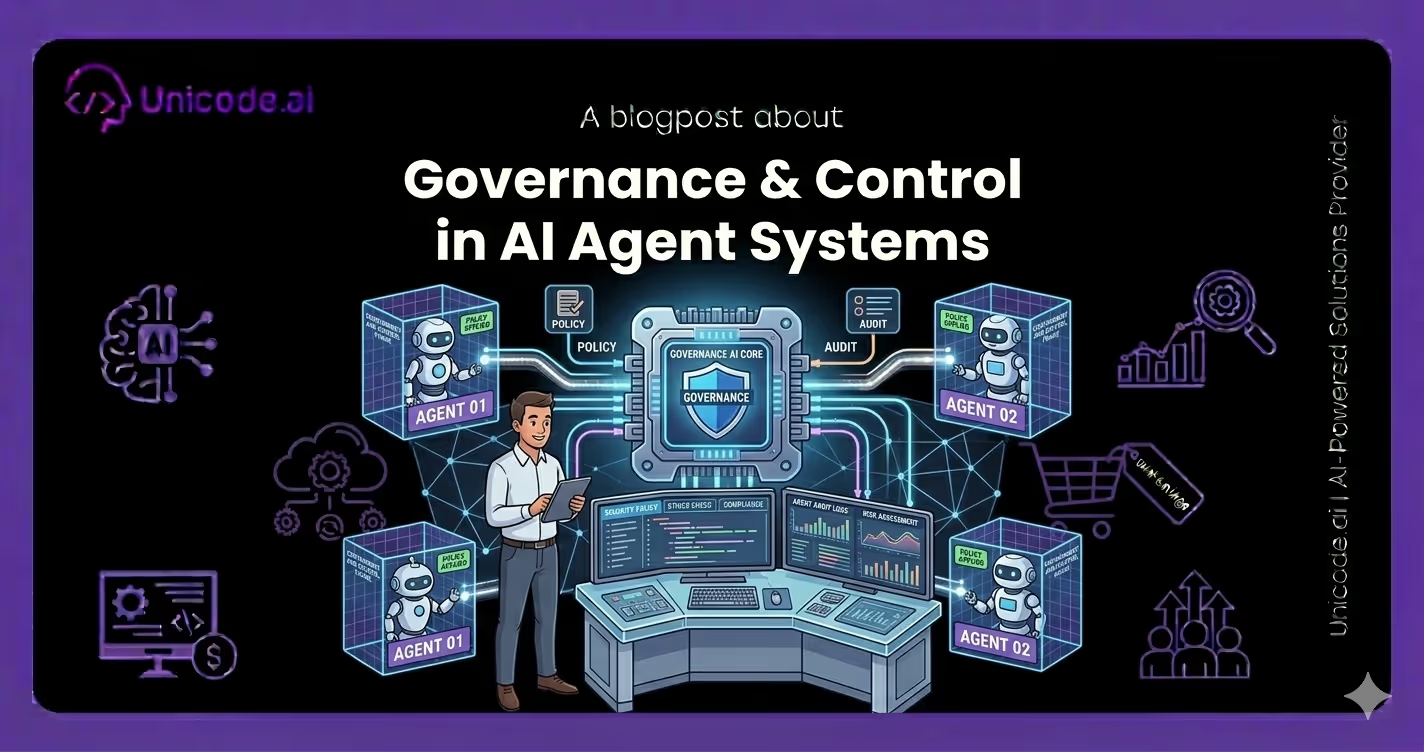
Governance & Control in AI Agent Systems
Enterprise AI adoption is accelerating faster than most organizations' ability to govern it. As AI agent systems move from controlled pilots into live business operations — taking autonomous actions, accessing sensitive data, making decisions at machine speed — the absence of a proper governance framework is not just a compliance risk. It is an operational one.
This guide covers everything enterprise leaders and technical teams need to establish effective governance and control over AI agent systems — from authority boundaries and audit trails to monitoring frameworks and regulatory alignment. If your organization is deploying or planning to deploy AI agents, this is the infrastructure that makes that deployment sustainable.
What Is Inside This Guide
- Why AI agent governance is different from traditional IT governance
- The core components of an AI agent governance framework
- Authority boundaries and permission architecture
- Human-in-the-loop design — when and how to implement it
- Audit trails and explainability requirements
- Monitoring, alerting, and performance governance
- Regulatory and compliance considerations
- Building a governance-first AI agent culture
- Frequently asked questions
1. Why AI Agent Governance Is Different from Traditional IT Governance
Traditional IT governance frameworks were designed for systems that do exactly what they are programmed to do — no more, no less. A database query returns data. A workflow automation rule triggers an action. The behavior is deterministic and predictable.
AI agent systems are fundamentally different. They reason. They make decisions. They select tools, interpret results, adjust their approach mid-task, and take actions that were not explicitly pre-programmed for every scenario. This non-deterministic behavior is precisely what makes them powerful — and precisely what makes traditional governance frameworks insufficient.
The three governance gaps traditional frameworks do not cover
Emergent behavior — AI agents can produce actions and outputs that were not anticipated during design. A well-governed AI agent system needs mechanisms to detect, log, and evaluate unexpected behavior — not just monitor for errors in predefined processes.
Autonomous action at scale — A single AI agent can execute hundreds of actions per hour across multiple systems. The volume and speed of autonomous action creates governance challenges that human oversight alone cannot address. Automated monitoring and control mechanisms are required.
Reasoning opacity — Unlike a traditional system where every decision follows explicit logic, AI agent decisions involve probabilistic reasoning that is not always immediately interpretable. Governance frameworks must include explainability requirements — the ability to reconstruct why an agent made a specific decision — especially for high-stakes business outcomes.
2. The Core Components of an AI Agent Governance Framework
A complete AI agent governance framework has six interconnected components. Each one addresses a distinct risk area and together they form a system of checks that allows autonomous AI operation within safe, controlled boundaries.
Authority and permission architecture defines what each agent is allowed to do — what data it can access, what systems it can write to, and what actions require human approval before execution.
Audit and logging infrastructure creates a complete, tamper-resistant record of every action every agent takes — what it was instructed to do, what tools it called, what data it accessed, and what output it produced.
Human-in-the-loop checkpoints establish the specific decision points where human approval is required before the agent proceeds — ensuring that high-stakes, irreversible, or high-risk actions are never taken autonomously.
Monitoring and alerting systems provide real-time visibility into agent behavior, performance metrics, and anomalies — with automated alerts when the system detects behavior outside defined parameters.
Model evaluation and quality governance establishes the processes for regularly evaluating agent output quality, detecting model drift, and managing the retraining and update cycles that keep the system performing reliably over time.
Regulatory and compliance alignment ensures the governance framework satisfies the specific legal, industry, and data privacy requirements that apply to your organization's deployment context.
3. Authority Boundaries and Permission Architecture
The most fundamental governance control in any AI agent system is defining — precisely and completely — what each agent is authorized to do. This is not a configuration detail. It is the architectural foundation of safe autonomous operation.
The principle of least privilege
Every agent in the system should have access only to what it needs to complete its specific function — nothing more. An agent responsible for reading and summarizing customer support tickets does not need write access to the CRM. An agent that generates draft communications does not need the ability to send them without human review. The principle of least privilege applied rigorously to every agent in the system dramatically reduces the blast radius of any error, malfunction, or adversarial input.
Tiered action authorization
Not all agent actions carry the same risk. A well-designed permission architecture organizes actions into tiers based on their reversibility, impact, and risk level.
Tier 1 — Fully autonomous actions are low-risk, easily reversible, and have no significant external impact. Reading data, generating drafts, running analysis, summarizing documents. These require no human approval.
Tier 2 — Notify and proceed actions have moderate impact but are within clearly defined operational parameters. The agent takes the action and simultaneously notifies a designated human. Sending a standard customer communication, updating a record within defined parameters, scheduling a meeting.
Tier 3 — Approve before proceeding actions are high-impact, irreversible, or carry significant business or compliance risk. Processing a financial transaction above a defined threshold, sending external communications outside standard templates, making commitments on behalf of the organization. These require explicit human approval before execution.
Tier 4 — Escalate immediately actions fall outside the agent's defined scope entirely. The agent stops, logs the situation, and routes to a human operator with full context. These include any action the agent is not confident it has authority to take, any situation involving potential legal or regulatory exposure, and any scenario that does not match its training distribution.
Permission boundaries table
4. Human-in-the-Loop Design — When and How to Implement It
Human-in-the-loop (HITL) is not a single feature — it is a design philosophy that determines how and where human judgment is embedded into autonomous AI workflows. Getting HITL design right is one of the most important governance decisions you will make.
The three HITL models
Approval-gated HITL places a human checkpoint at specific action points in the workflow. The agent prepares everything — gathers data, runs analysis, drafts the proposed action — and presents it to a human approver with full context. The human reviews and either approves, rejects, or modifies the proposed action. This model is used for Tier 3 actions and any workflow with significant external impact.
Monitoring-based HITL allows the agent to operate autonomously but puts a human in a continuous oversight role — reviewing a live dashboard of agent actions, with the ability to intervene, pause, or override at any point. This model is appropriate for high-volume, lower-risk workflows where real-time oversight is more practical than pre-action approval.
Exception-based HITL lets the agent handle everything within its defined parameters autonomously and only surfaces items to a human when the agent encounters a situation it cannot confidently resolve. This model is the most efficient for mature, well-tested deployments where the agent's performance on standard cases is highly reliable.
Designing effective approval interfaces
The quality of your HITL implementation depends heavily on how well the approval interface is designed. A human approver who receives a cryptic summary of an agent's proposed action cannot make a good decision quickly. Effective approval interfaces present the full context of what the agent was trying to accomplish, a clear description of the proposed action, the data and reasoning that led to it, the expected outcome, and a simple approve, reject, or modify control. When approvers have what they need to decide confidently in under 60 seconds, the HITL checkpoint adds oversight without creating operational friction.
5. Audit Trails and Explainability Requirements
Every action taken by every agent in your system must be logged in a way that allows you to reconstruct exactly what happened, why, and with what outcome. This is not just a compliance requirement — it is a fundamental operational capability.
What a complete audit trail must capture
A governance-grade audit trail captures the agent's identity and version, the task instruction it received, every tool call it made and the parameters passed, every data source it accessed, the output it produced at each step, the decision the orchestrator made based on that output, whether human approval was sought and what the response was, the timestamp of every event, and the final outcome of the workflow. Nothing less than this level of completeness gives you the visibility needed to debug problems, demonstrate compliance, and continuously improve the system.
Explainability for high-stakes decisions
For workflows where agent decisions have significant consequences — approving or rejecting a customer application, flagging a transaction as potentially fraudulent, recommending a clinical pathway — explainability is a governance requirement, not a nice-to-have. Your system must be able to generate a human-readable explanation of why the agent reached a specific conclusion. This requires deliberate architectural choices during the build phase — explainability cannot be retrofitted easily into systems that were not designed with it in mind.
Audit log retention and access controls
Audit logs must be stored in a tamper-resistant environment with strict access controls. Define retention periods that satisfy your regulatory requirements — typically a minimum of two to seven years for enterprise applications in regulated industries. Implement role-based access so that audit logs are accessible to compliance, security, and designated governance personnel but not to general users or the agent systems themselves.
6. Monitoring, Alerting, and Performance Governance
A governance framework without real-time monitoring is a governance framework on paper only. Production AI agent systems require continuous visibility into their behavior and performance.
The five metrics every AI agent system must track
Task completion rate measures what percentage of tasks the agent completes successfully without human intervention or error. Declining completion rates are an early signal of model drift or changing input patterns that the agent was not trained for.
Escalation rate measures how frequently the agent escalates to human operators. An escalation rate that is rising over time indicates the agent is encountering more situations outside its training distribution — a signal that retraining or scope adjustment may be needed.
Action accuracy rate measures the percentage of agent actions that are confirmed as correct by human reviewers or downstream outcome data. This is your primary quality metric.
Processing time per task measures how long the agent takes to complete defined workflow tasks. Significant increases in processing time can indicate infrastructure issues, prompt complexity problems, or upstream data quality degradation.
Error and exception rate tracks how frequently the agent encounters errors in tool calls, API connections, or data processing. Rising error rates often indicate integration issues that need technical attention before they affect business operations.
Monitoring and alerting infrastructure
7. Regulatory and Compliance Considerations
The regulatory landscape for AI systems is evolving rapidly. Organizations deploying AI agents need to align their governance frameworks with the specific requirements that apply to their industry and geography.
EU AI Act
The European Union AI Act — which entered into force in 2024 — classifies AI systems by risk level and imposes governance requirements proportional to that classification. AI systems used in high-risk contexts — hiring, credit scoring, critical infrastructure, healthcare — face the most stringent requirements including mandatory human oversight, transparency obligations, and conformity assessments. Organizations deploying AI agents in any EU-adjacent context need to understand where their systems fall in the risk classification framework.
GDPR and data privacy
AI agent systems that process personal data are subject to GDPR in Europe and equivalent data privacy regulations in other jurisdictions. Key requirements include data minimization — agents should access only the personal data necessary for the specific task — purpose limitation, the right to explanation for automated decisions, and data retention limits. These requirements must be built into the agent's permission architecture and audit infrastructure from the beginning, not added as an afterthought.
Industry-specific regulations
Healthcare deployments must align with HIPAA requirements for protected health information. Financial services deployments must satisfy relevant financial conduct regulations and model risk management guidelines. Legal and professional services deployments must address privilege, confidentiality, and professional responsibility obligations. Each industry adds a layer of compliance requirements on top of general data privacy law that your governance framework must explicitly address.
8. Building a Governance-First AI Agent Culture
Technical governance infrastructure is necessary but not sufficient. Sustainable AI agent governance requires organizational culture and processes that treat governance as a continuous operational responsibility — not a one-time deployment checklist.
Designate a governance owner for every deployment
Every live AI agent system needs a named individual who owns its governance — responsible for monitoring performance metrics, managing escalations, overseeing retraining cycles, maintaining the audit trail, and ensuring ongoing regulatory alignment. Without a designated owner, governance responsibilities diffuse and governance quality degrades over time.
Establish a governance review cadence
Schedule formal governance reviews on a defined cadence — monthly for new deployments, quarterly for mature systems. Each review should cover performance metrics against defined thresholds, any incidents or anomalies observed since the last review, changes in the business context that may affect the agent's scope or authority boundaries, regulatory updates that may require framework adjustments, and planned improvements to the system.
Train the humans who work alongside agents
Every person whose workflow involves interacting with, supervising, or approving actions from an AI agent system needs training on how the system works, what its authority boundaries are, how to evaluate its outputs critically, and how to escalate concerns. Human oversight is only effective when the humans providing it are equipped to do so confidently and correctly.
Treat governance incidents as learning opportunities
When an AI agent takes an action it should not have, produces an output that was incorrect, or encounters a scenario it handled poorly — the response should be systematic investigation and improvement, not blame assignment. Document every incident thoroughly, identify the root cause, implement a governance improvement, and update the training or permission architecture to prevent recurrence. An organization that treats governance incidents this way builds continuously improving AI systems. One that treats them as embarrassments to be minimized builds fragile ones.
Deploying AI agents in your enterprise and need a governance framework built in from the start? Unicode AI designs AI agent systems with governance, control, and compliance infrastructure built into the architecture — not added as an afterthought. Talk to our team to discuss your deployment.
Frequently Asked Questions (FAQs)
AI agent governance is the framework of policies, controls, monitoring systems, and processes that ensure AI agents operate within defined boundaries, behave reliably, and remain aligned with business and regulatory requirements. It matters because AI agents take autonomous action — without governance, that autonomy creates operational, legal, and reputational risk that grows with the scale of deployment.
AI compliance refers to meeting specific regulatory or legal requirements — GDPR, EU AI Act, HIPAA. AI governance is broader — it encompasses compliance but also includes internal controls, performance management, human oversight design, audit infrastructure, and the organizational processes that ensure the system continues to operate safely and effectively over time. Compliance is a subset of governance.
Through a combination of permission architecture that restricts what each agent is technically capable of doing, tiered authorization that requires human approval for high-risk actions, real-time monitoring that detects anomalous behavior, and audit trails that create accountability for every action. No single control is sufficient — robust governance requires all of these layers working together.
A complete audit trail should capture the agent identity and version, task instruction received, every tool call and parameter, every data source accessed, outputs produced at each step, orchestrator decisions, human approvals sought and received, timestamps for every event, and the final workflow outcome. This level of completeness is required for effective debugging, compliance demonstration, and continuous improvement.
New deployments should be reviewed monthly for the first six months. Mature deployments should undergo formal quarterly reviews. Any significant change to the agent's scope, the business context it operates in, or the regulatory environment it is subject to should trigger an immediate governance review regardless of the regular schedule.
The first step is identifying the highest-value use case in your organization using the criteria outlined in Section 6, followed by an AI readiness assessment to evaluate your data environment and integration readiness. This gives you a realistic picture of what is deployable now versus what requires preparation first.