AI Applications
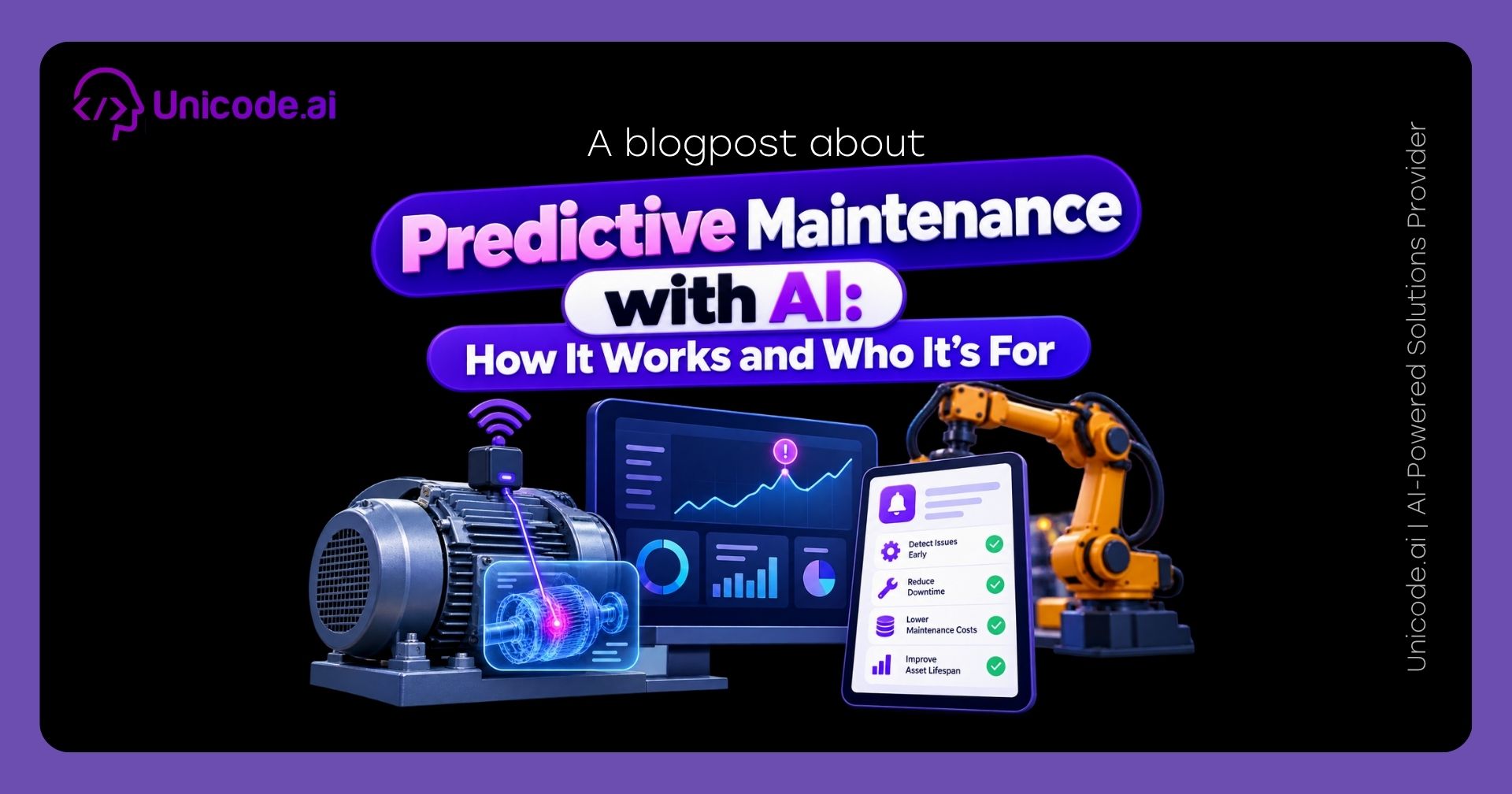
Predictive Maintenance with AI: How It Works and Who It's For
Introduction
Most maintenance still happens on a fixed schedule or after something breaks — both of which waste money in opposite directions, either servicing equipment that didn't need it or reacting to a failure that already cost you downtime. AI-based predictive maintenance replaces both with a third option: predicting the failure before it happens, based on how the equipment is actually behaving. This guide explains how that actually works and which industries are seeing real, measurable returns from it.
TL;DR
AI predictive maintenance uses sensor data and machine learning to detect early signs of equipment failure before it happens, replacing fixed-schedule or reactive maintenance. Real deployments report meaningful ROI — from a 310% ROI/6-month payback in manufacturing to a 51% increase in train reliability in rail transport. It works best where equipment failure is costly and sensor data is available to monitor condition continuously.
Key Facts
- The global predictive maintenance market was valued at $14.2 billion in 2025 and is projected to grow from $17.5 billion in 2026 to $98.1 billion by 2033, a 27.9% CAGR (Grand View Research, 2026).
- Augury's manufacturing-focused predictive maintenance platform reports a Forrester-cited 310% ROI with under 6-month payback, drawing on 1.1 billion-plus hours of machine monitoring data across 300,000+ diagnosed machines (Augury, 2026).
- IBM Maximo's real customer deployments include Downer (rail transport) achieving a 51% increase in train reliability, and Transport for London projecting £21 million in savings over ten years (IBM, 2026).
What Predictive Maintenance With AI Actually Means
Traditional maintenance runs on one of two models: scheduled (servicing equipment at fixed intervals regardless of actual condition) or reactive (fixing it after it breaks). Both waste resources — scheduled maintenance often replaces parts that had life left, while reactive maintenance means unplanned downtime already happened. Predictive maintenance uses continuous sensor data and machine learning to detect the early signatures of an impending failure, so maintenance happens exactly when the equipment's actual condition calls for it — not before, not after.
How It Works: From Sensor Data to a Maintenance Alert
Continuous Condition Monitoring
Sensors attached to equipment continuously capture data — vibration, temperature, acoustic signatures, energy draw — that reflects the machine's actual operating condition, feeding a constant stream of real-world data rather than a periodic manual inspection.
Pattern and Anomaly Detection
Machine learning models trained on historical failure patterns identify subtle deviations from normal operating behavior that precede a breakdown, often detecting the earliest signs well before a human inspector would notice anything unusual.
Alerting and Prescriptive Action
Once a likely failure is flagged, the system alerts maintenance teams with enough lead time to schedule a repair proactively — and more advanced platforms go further, recommending the specific corrective action rather than just flagging that something is wrong.
Who It's For: Industries Where This Delivers Real ROI
Manufacturing
Augury's platform, deployed across 170+ global manufacturing customers, illustrates the manufacturing use case directly — one customer reported increasing uptime from the 65-70% range to 85-90% after implementation, a substantial jump directly tied to catching failures before they caused unplanned stoppages.
Infrastructure and Transport
IBM Maximo's real customer results extend the case beyond factories: Downer achieved a 51% increase in train reliability, Transport for London projects £21 million in savings over ten years, and Sund & Bælt Infrastructure reports 750,000 tons of CO2 emissions saved by extending asset lifespan through condition-based maintenance rather than premature replacement.
Any Operation Where Downtime Is Expensive and Equipment Is Instrumentable
The common thread across both categories isn't the industry itself — it's whether unplanned downtime is costly enough to justify the sensor investment, and whether the equipment can actually be instrumented to produce the condition data the models need.
What Real Deployments Actually Delivered
Paste the block below into a Webflow HTML Embed element — it will not render correctly in the rich text area.
Getting Started: What You Need Before You Can Predict Anything
Predictive maintenance depends entirely on data quality, so the real starting point isn't choosing software — it's confirming your equipment can be instrumented with the right sensors, and that you have (or can build) enough historical failure data for a model to learn meaningful patterns from. Augury's reported average of roughly 30 days to first improvement suggests this doesn't have to be a multi-year initiative once the sensor and data foundation is in place, but skipping that foundation is the most common reason predictive maintenance projects stall.
Common Pitfalls & Fixes
Deploying sensors without enough historical failure data. Models need examples of what failure looks like to learn from — a data collection phase often has to precede meaningful predictions.
Choosing equipment to instrument based on convenience rather than cost of downtime. Prioritize the assets where unplanned failure is most expensive, not the easiest to wire up.
Treating the alert as the end of the process. An early warning only has value if maintenance teams have a defined process to act on it quickly.
Expecting immediate ROI before the system has learned your specific equipment's patterns. Give it a defined runway — Augury's own data points to roughly a month to first improvement, not immediate results on day one.
Ignoring the sustainability angle when building the business case. Extended asset life and reduced emissions, as seen in the Sund & Bælt case, can strengthen the ROI argument beyond pure downtime savings.
Real-World Examples
Augury: Manufacturing at Scale
Augury's reported 310% ROI and sub-6-month payback, backed by over a billion hours of machine monitoring data across 300,000+ machines, represents one of the most quantified predictive maintenance deployments publicly available in manufacturing.
IBM Maximo: Infrastructure and Public Transit
IBM Maximo's named customer results — Downer's 51% reliability increase, Transport for London's £21 million projected savings — show predictive maintenance delivering measurable value well beyond the factory floor, into public infrastructure where failure costs are measured in service disruption as much as dollars.
Methodology
Statistics in this guide were verified directly against Augury's and IBM's own published pages in September 2026, including their cited customer case results. Market data comes from Grand View Research's published predictive maintenance market report. Live web search was unavailable for this piece, so verification relied on direct primary-source fetches. Limitations: vendor-published case results reflect specific deployments and may not generalize to every equipment type or industry.
Conclusion
AI predictive maintenance works best where equipment failure is genuinely costly and the equipment can be instrumented to produce reliable condition data — not as a universal replacement for every maintenance schedule. The real-world results from both manufacturing and infrastructure deployments show the ROI is measurable, but it depends on getting the data foundation right before expecting predictions. If you're evaluating whether your operation has the right conditions for this to work, that's worth mapping out before choosing a platform.
FAQ
What is AI predictive maintenance?
It's the use of sensor data and machine learning to detect early signs of equipment failure before it happens, so maintenance can be scheduled proactively instead of on a fixed calendar or after a breakdown.
How is predictive maintenance different from preventive maintenance?
Preventive maintenance follows a fixed schedule regardless of actual equipment condition; predictive maintenance responds to the equipment's real, continuously monitored condition.
What industries benefit most from AI predictive maintenance?
Manufacturing and infrastructure/transport show the strongest documented results, but any operation where downtime is expensive and equipment can be instrumented can benefit.
How long does it take to see results from predictive maintenance AI?
Real deployments report meaningful improvement within roughly a month once sensors and historical data are in place, though building that data foundation takes time upfront.
Do I need new equipment to use AI predictive maintenance?
No — most platforms work by retrofitting sensors onto existing equipment rather than requiring new machinery.