AI Applications
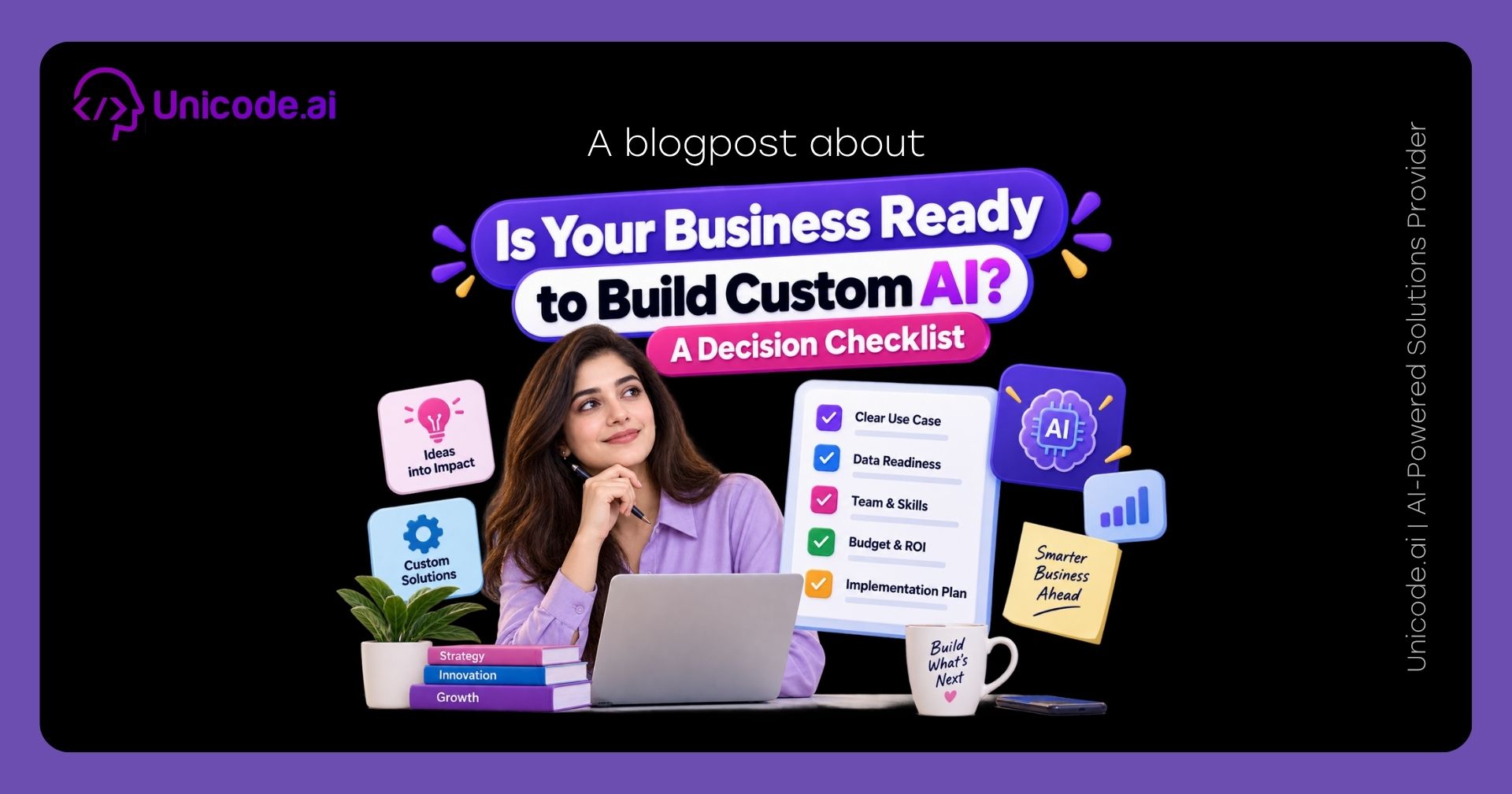
Is Your Business Ready to Build Custom AI? A Decision Checklist
Introduction
"Should we build custom AI?" is the wrong first question, because almost every business could benefit from some form of AI — that's not the decision that matters. The real question is whether your specific situation justifies the cost and time of a custom build over configuring a tool that already exists. This checklist walks through the five signals that actually indicate custom AI development is the right call, and just as importantly, the signals that mean you're not ready yet, no matter how much budget or leadership enthusiasm you have.
TL;DR
Custom AI development makes sense when you've hit a real ceiling with off-the-shelf tools, your data or workflow is a genuine competitive advantage worth protecting, and you have the in-house capacity to maintain what you build. It does not make sense just because budget exists, leadership is excited, or a competitor announced something similar.
Key Facts
- Only 22% of organizations have successfully scaled AI across multiple business units as of September 2026 — meaning most "AI readiness" failures happen after the build decision, in execution (Gartner, 2026).
- 32% of organizations have decided against purchasing a software product or feature because they could build the functionality in-house using agentic coding tools — and that figure rises to nearly half among high-performing organizations (McKinsey, 2026).
- Technology and healthcare report the highest rates of choosing in-house builds over vendor purchases, followed by professional services and energy/materials (McKinsey, 2026).
- 93% of audit functions already use AI in some form, yet 60% still lack a formal strategy governing that use — a reminder that adoption and readiness are not the same thing (Gartner, 2026).
Why "Do We Need Custom AI" Is the Wrong First Question
Most teams start by researching what custom AI development actually is, comparing it against off-the-shelf tools in the abstract. That's useful background, but it doesn't answer whether your business specifically needs it right now. The better starting point is auditing your own constraints — what's actually blocking you today, and whether a configuration change to an existing tool could remove that block before you commit to a multi-month build.
The Five Signals That Mean You're Ready to Build Custom
You've Hit a Real Configuration Ceiling
Not "the interface is annoying" — a genuine functional wall where the off-the-shelf platform cannot do what your workflow requires, no matter how it's configured. If you've already tried workarounds, plugins, and vendor feature requests and still can't get there, that's a real signal.
Your Data or Workflow Is a Competitive Advantage
If the exact way you process a customer request, price a job, or route an internal approval is part of what makes you better than competitors, building that logic into a generic tool everyone else can also configure erodes the advantage rather than protecting it.
You Have In-House Capacity to Maintain It
Custom software doesn't end at launch — it needs ongoing maintenance, monitoring, and updates as your business changes. The rise of agentic coding tools has lowered the bar here significantly, but "lower" isn't "zero," and someone on your team needs to own it long-term.
The Off-the-Shelf Cost Curve Doesn't Work at Your Scale
Per-seat or per-usage pricing that's reasonable at 10 users can become the more expensive option at 500, especially once you factor in per-feature add-ons. Model your cost at your actual scale, not your current scale, before ruling custom development out on price.
You Can Define Success Before You Start
Teams that can articulate a specific, measurable outcome ("cut manual review time by 40%") before writing a line of code are dramatically more likely to ship something worth the investment than teams building toward a vague sense that "we should have AI here."
The Decision Scorecard
What "Ready" Doesn't Mean
Having budget approved doesn't mean you're ready — it means finance said yes, which is a different question from whether the problem justifies a custom build. Leadership excitement doesn't mean you're ready either; enthusiasm fades fast once the first maintenance ticket arrives, and it's a poor substitute for a defined success metric. And a competitor announcing an AI feature isn't a readiness signal for you specifically — their data, workflow, and constraints aren't yours, and matching their announcement isn't the same as solving your own bottleneck.
The Middle Path: Hybrid and Phased Approaches
You don't have to choose between "build everything custom" and "accept an off-the-shelf tool's limits" as a binary. A common middle path is starting with a narrow custom layer on top of an existing platform — using its API to add the one piece of custom logic you actually need, rather than replacing the whole system. Another is a phased build: ship a narrow custom MVP addressing your single highest-friction workflow first, prove the defined success metric, and only expand scope once that's validated. This reduces the cost of being wrong about readiness, since a failed narrow pilot costs far less than a failed full build.
Common Pitfalls & Fixes
Treating "we have the budget" as the readiness signal. Budget answers whether you can afford it, not whether the problem justifies it — score against the five signals above regardless of budget size.
Skipping the configuration-ceiling test. Confirm you've genuinely exhausted the off-the-shelf tool's settings and vendor roadmap before concluding you need a custom build.
Assuming agentic coding tools eliminate maintenance cost. They lower the cost of writing code, not the cost of owning it long-term — you still need a maintenance owner.
Building toward a vague goal. "We should have AI here" is not a success metric — define the measurable outcome before scoping the build.
Ignoring cost at future scale. Model pricing at your growth target, not your current headcount, before ruling custom development out on price alone.
Copying a competitor's announcement instead of your own bottleneck. Their AI investment solves their constraints, not necessarily yours.
Real-World Examples
The Off-the-Shelf Ceiling in Practice
Agencies using white-label platforms like Vendasta or HighLevel often hit a real configuration ceiling once their client base grows past what the platform's sub-account or catalog structure was designed for — a concrete, testable signal rather than a vague sense of outgrowing the tool.
Agentic Coding Tools Changing the Calculus
The rise of tools like GitHub Copilot has measurably shifted the build-vs-buy math — McKinsey's finding that 32% of organizations now build in-house instead of buying reflects real cost reduction in writing custom code, not just enthusiasm for building.
When Off-the-Shelf Still Wins
Teams using infrastructure-heavy platforms like Twilio for messaging or Chatbase for a single chatbot use case often stay off-the-shelf indefinitely, because the underlying infrastructure (carrier relationships, model hosting) isn't something replicating in-house would ever be cost-effective.
Methodology
The statistics in this checklist come directly from Gartner's and McKinsey's own published September 2026 research releases, verified via their own sites rather than secondary summaries. Live web search was unavailable for this piece, so verification relied on direct primary-source fetches. Limitations: both cited reports are large, cross-industry surveys, and figures may not map precisely onto any single company's situation — use them as directional context for the scale of the build-vs-buy shift, not as a benchmark for your specific project.
Conclusion
Readiness for custom AI development isn't about budget, enthusiasm, or what a competitor did — it's about whether you've hit a genuine configuration ceiling, whether your workflow is worth protecting as a competitive advantage, and whether someone will actually own what gets built. Run your situation against the five signals and the scorecard above before scoping anything. If you want a second opinion on where your specific situation lands, that's a conversation worth having before committing budget either way.
FAQ
How do I know if I actually need custom AI development? Check whether you've hit a genuine configuration ceiling with existing tools, whether your workflow is a real competitive advantage, and whether you have in-house capacity to maintain what gets built — budget and enthusiasm alone aren't readiness signals.
Is it cheaper to build custom AI now that coding tools have improved? Agentic coding tools have lowered the cost of writing custom software, which is part of why 32% of organizations now choose to build rather than buy, but maintenance and ownership costs remain a separate factor to plan for.
What's a lower-risk way to test if custom AI is right for us? Start with a narrow custom MVP targeting your single highest-friction workflow, or add a custom layer on top of an existing platform's API, rather than committing to a full custom build immediately.
Does having budget approved mean we're ready to build custom AI? No — budget approval answers whether you can afford it, not whether your situation justifies it over an off-the-shelf alternative.
Should we build custom AI because a competitor just launched an AI feature? Not on its own — their build addresses their specific data and workflow constraints, which may be entirely different from yours.