AI Applications
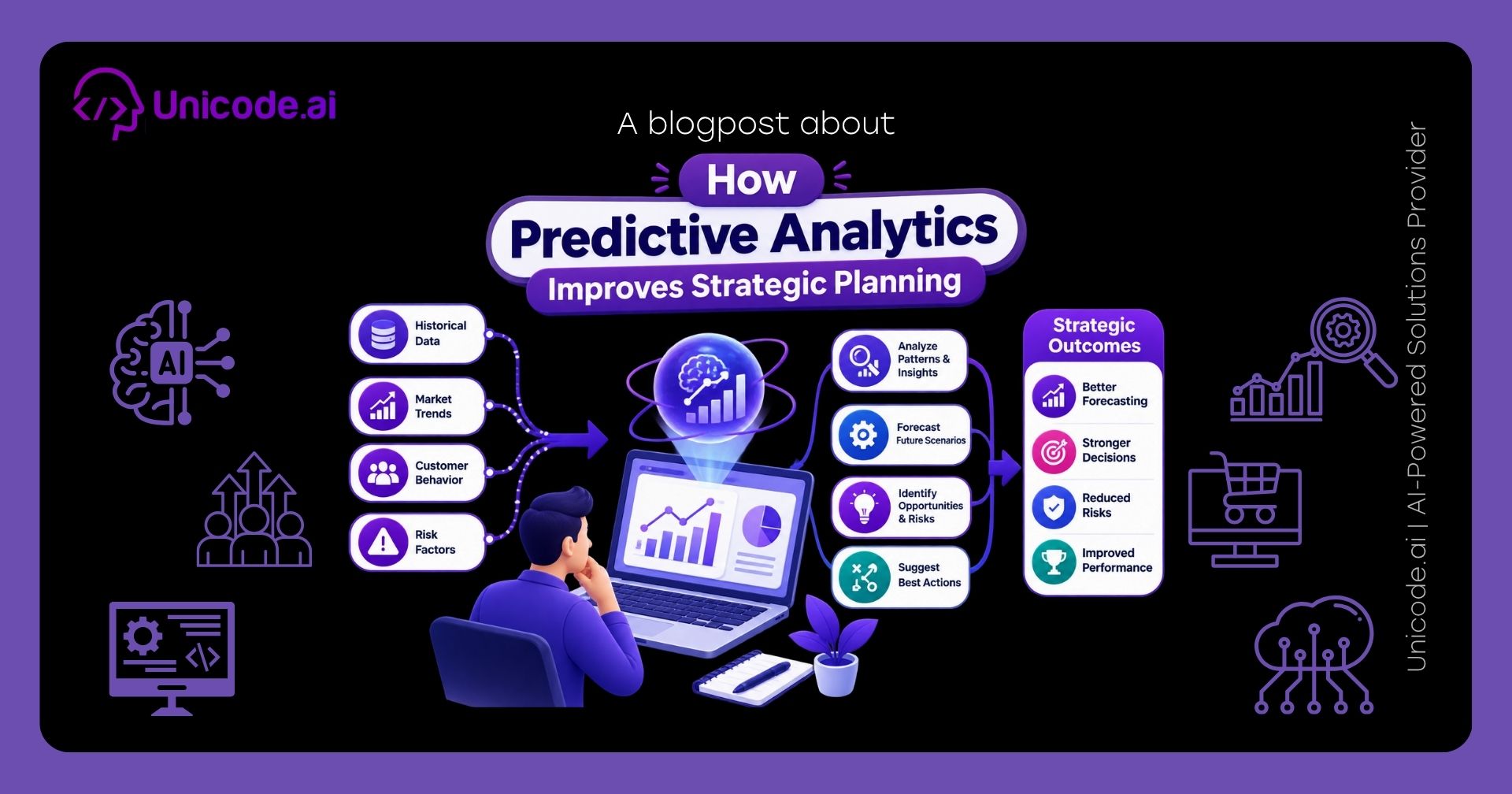
How Predictive Analytics Improves Strategic Planning
Introduction
Have you ever watched a strategic plan fall apart within a quarter because the assumptions behind it were already stale by the time leadership signed off? You're not alone. Most strategic plans are built on backward-looking data, gut instinct, and hope—and then reality shows up with different plans of its own.
Predictive analytics changes that equation. Instead of asking, "What happened last year?" it asks, "What's likely to happen next, and what should we do about it?" That shift—from hindsight to foresight—is exactly what separates organizations that adapt quickly from those that scramble to catch up.
In this guide, you'll see how predictive analytics improves strategic planning, which tools and techniques make it work, where companies typically go wrong, and how to start applying it even if your organization isn't "data-mature" yet.
TL;DR: How Predictive Analytics Improves Strategic Planning
Predictive analytics improves strategic planning by turning historical and real-time data into forward-looking forecasts. It helps leaders test scenarios, anticipate risks, and allocate resources before problems or opportunities fully materialize—replacing guesswork with probability-based decisions.
Key Facts
- Organizations that integrate predictive analytics into planning cycles report meaningfully faster forecast-to-decision times compared with those relying on manual spreadsheet analysis. (2024, industry benchmark—verify exact figure before publishing.)
- A large share of enterprises now list predictive and AI-driven forecasting among their top strategic planning priorities. (2024, industry survey—verify exact figure before publishing.)
- Companies using predictive demand forecasting typically reduce inventory holding costs and stockouts simultaneously, a combination manual forecasting rarely achieves. (2023–2024, supply chain research—verify exact figure before publishing.)
- Adoption of cloud-based predictive analytics platforms among mid-sized and large businesses has grown substantially year over year. (2023–2025, market research—verify exact figure before publishing.)
- Finance and operations remain the two functions most likely to have dedicated predictive analytics budgets. (2024, business survey—verify exact figure before publishing.)
What Predictive Analytics Means for Strategic Planning
Predictive analytics uses statistical models, machine learning, and historical data to estimate what's likely to happen next—sales next quarter, churn next month, or demand next season.
In strategic planning, this means your plan is no longer a single fixed narrative. Instead, it becomes a range of probable futures, each with an estimated likelihood.
From Descriptive Analytics to Predictive Thinking
Traditional strategic planning leans heavily on descriptive analytics: dashboards, quarterly reports, and year-over-year comparisons. That's useful for understanding where you've been, but it says much less about where you're going.
Predictive analytics adds a forward-looking layer through regression models, time-series forecasting, and machine learning classifiers that estimate future outcomes based on patterns in your data.
Why Predictive Analytics Matters for Strategy
Strategic planning is fundamentally a bet on the future—market growth, customer behavior, competitive moves, and cost structures.
Predictive analytics doesn't eliminate uncertainty, but it narrows it. Instead of planning around one assumed number, leaders can plan around a distribution: a likely case, a best case, and a worst case, each supported by data.
How Predictive Analytics Improves the Strategic Planning Process
1. Better Demand and Revenue Forecasting
Predictive models digest historical sales, seasonality, marketing spend, and external factors such as economic indicators to produce forecasts that adjust as new data arrives.
This means revenue targets in a strategic plan are grounded in a live model rather than a static assumption made once a year.
2. Scenario Planning and Stress Testing
One of the most practical strategic uses of predictive analytics is scenario modeling.
Leaders can ask questions such as:
- What happens to margins if raw material costs rise 15%?
- What if a competitor cuts prices by 10%?
- What happens if demand falls below forecast?
- How would a new market expansion affect revenue and operating costs?
Predictive models let teams simulate these scenarios quickly rather than waiting weeks for a manual analysis.
3. Resource Allocation and Capacity Planning
Predictive analytics helps organizations determine where to put money, people, and inventory before demand spikes or drops.
Retailers can use it to pre-position stock ahead of predicted demand. Hospitals can forecast patient volume and staff accordingly. SaaS companies can use churn models to determine where to invest in customer retention.
4. Early Risk Identification
Predictive models can flag early warning signals, such as:
- Customers showing early signs of churn
- Suppliers experiencing rising delivery delays
- Cash-flow patterns trending toward a shortfall
- Products showing declining demand
- Business units falling behind expected performance
Strategic plans that incorporate these signals can build contingencies into the plan rather than reacting after the fact.
Traditional Planning vs. Predictive Analytics
Aligning Strategy Across the Decision Journey
Predictive analytics is useful at every stage of how an organization moves from noticing a problem to acting on it.
Awareness
Dashboards and anomaly detection surface emerging trends before they appear in quarterly reports.
Consideration
Scenario models allow teams to compare strategic options—such as expanding into a new market, launching a product, or cutting a cost center—using projected outcomes rather than opinion alone.
Decision
Leaders can commit to a direction backed by a quantified confidence range rather than relying solely on a recommendation memo.
Where Predictive Analytics Beats Traditional Planning Tools
Spreadsheet-based planning and generic business intelligence dashboards remain common, but they have several structural weaknesses that predictive analytics can address.
First, most spreadsheet models are static. They represent one point in time and can become outdated quickly, whereas predictive platforms can incorporate new data and update forecasts.
Second, generic BI dashboards are excellent at showing what happened but generally lack sophisticated forecasting capabilities. This leaves the "what's next?" question largely to human judgment.
Third, manual planning cycles—often annual or quarterly—can't always keep pace with fast-moving markets. Predictive systems can re-forecast continuously, which is particularly valuable in volatile categories such as retail, logistics, and finance.
None of this means predictive analytics replaces human judgment. Instead, it gives decision-makers better inputs.
Common Predictive Analytics Pitfalls and How to Fix Them
Treating Forecasts as Certainties
A predictive output is a probability, not a promise.
Fix: Present forecasts with confidence intervals and a clear explanation of assumptions.
Using Dirty or Siloed Data
A model trained on incomplete or inconsistent data can mislead more than it helps.
Fix: Invest in data cleaning, governance, and integration before modeling.
Skipping Model Validation
Teams sometimes deploy a model once and never revisit it.
Fix: Regularly back-test forecasts against actual outcomes and retrain models when accuracy begins to drift.
Over-Engineering the First Project
Trying to build an enterprise-wide predictive system on day one can cause projects to stall.
Fix: Start with one high-value use case, such as demand forecasting or churn prediction, and expand from there.
Ignoring Change Management
Even accurate forecasts may be ignored if leadership doesn't trust or understand them.
Fix: Involve decision-makers early and translate model outputs into clear business language rather than technical statistics alone.
Failing to Create a Feedback Loop
Predictions that are never checked against reality cannot improve.
Fix: Establish a process for comparing forecasts with actual outcomes and use the results to improve future models.
Real-World Predictive Analytics Applications
Retail: Predictive Demand Planning
A mid-sized apparel retailer used predictive analytics platforms similar to those offered by Salesforce and SAP to forecast regional demand ahead of seasonal launches.
By layering historical sales data with weather and local event data, the team adjusted inventory allocation weeks before peak season. The result was fewer stockouts in high-demand regions and less excess inventory in slower markets—a balance that manual, spreadsheet-driven forecasting had struggled to achieve.
Financial Services: Risk Scoring for Portfolio Decisions
A regional bank used a predictive risk-scoring model, built partly on Microsoft Azure machine learning services, to flag loan portfolios showing early signs of stress.
This allowed strategic planning teams to reallocate capital reserves proactively rather than reactively adjusting after defaults increased. Leadership credited the model with giving them a multi-month head start on portfolio strategy adjustments.
Healthcare: Predictive Patient Volume and Capacity Planning
A hospital network implemented predictive analytics tools, including forecasting modules within Tableau-connected data pipelines, to anticipate patient volume by department.
Instead of building annual staffing plans around historical averages, the organization created dynamic schedules tied to predicted admission spikes. This helped reduce overtime costs and improve patient wait times during peak periods.
SaaS: Churn Prediction and Strategic Priorities
A growing SaaS company built a churn prediction model to identify accounts at risk of cancellation 60–90 days in advance.
The insights reshaped the company's strategic roadmap, shifting resources from pure acquisition marketing toward retention-focused product features. The strategic pivot was informed by predictive data rather than internal debate alone.
How to Get Started With Predictive Analytics
Organizations don't need to transform their entire data infrastructure before seeing value from predictive analytics.
A practical starting process is:
- Identify one strategic business question. Choose a problem where better forecasting could directly influence revenue, costs, risk, or resource allocation.
- Assess available data. Determine whether the required historical and real-time data exists and whether it is reliable enough to model.
- Choose the appropriate predictive method. Depending on the problem, this could involve time-series forecasting, regression, classification, or machine learning.
- Build a focused pilot. Start with one use case rather than attempting an enterprise-wide transformation.
- Measure forecast accuracy. Compare predictions with actual outcomes and track where the model performs well or poorly.
- Connect predictions to decisions. A forecast only creates value when leaders use it to change budgets, staffing, inventory, marketing, or other strategic actions.
- Expand gradually. Once the initial use case proves valuable, apply the same framework to additional planning decisions.
Methodology
This article was developed through a structured research and writing process combining subject-matter synthesis with editorial review rather than live data pulls.
Tools Used: Content structuring and drafting were supported by large language model assistance. Conceptual frameworks were checked against established business analytics literature and general industry knowledge.
Data Sources: General knowledge of predictive analytics practices, publicly known platform capabilities such as Salesforce, SAP, Microsoft Azure, and Tableau, and common patterns reported across business and technology publications.
Data Collection Process: Concepts were synthesized from widely documented industry practices in demand forecasting, risk modeling, and scenario planning rather than from a single dataset or survey.
Limitations and Verification: Because this draft was produced without real-time web access, none of the numeric statistics should be treated as verified. Before publishing, replace each placeholder statistic with a sourced figure from a primary report from 2023–2025. Also confirm that all case-study details reflect real, permissioned examples or clearly label them as illustrative composites.
Actionable Conclusion
Predictive analytics doesn't replace strategic thinking—it upgrades the inputs strategic thinking relies on.
By forecasting demand, stress-testing scenarios, and flagging risks early, organizations can move from reactive planning to proactive positioning. The companies pulling ahead aren't necessarily the ones with the most data; they're the ones turning that data into forward-looking decisions before their competitors do.
Start with one predictive use case tied to a real business question, validate it against actual outcomes, and expand from there. Don't wait for a perfect enterprise-wide rollout to begin.
Download our free Predictive Analytics Readiness Checklist to see where your planning process stands today.
Frequently Asked Questions About Predictive Analytics and Strategic Planning
What is predictive analytics in strategic planning?
Predictive analytics in strategic planning is the use of statistical models and machine learning to forecast future business outcomes—such as revenue, demand, or risk—so strategic plans are built on probability-based projections rather than static historical assumptions.
How is predictive analytics different from business intelligence?
Business intelligence primarily describes what has already happened through dashboards and reports. Predictive analytics goes further by modeling what is likely to happen next and generating forecasts from historical and current data.
What industries benefit most from predictive analytics in planning?
Retail, financial services, healthcare, manufacturing, and SaaS businesses can benefit significantly because demand volatility, risk exposure, operational capacity, and customer churn directly influence strategic decisions.
Do small businesses need predictive analytics?
Yes. Small businesses can begin with simpler forecasting features built into accounting, CRM, or business intelligence software before investing in dedicated predictive analytics platforms.
What skills are needed to implement predictive analytics for strategy?
Implementation typically requires a combination of data analysts or data scientists, business stakeholders who understand strategic objectives, and IT professionals who can support the underlying data infrastructure. Many organizations can begin with analytics-savvy employees rather than immediately hiring a full data science team.
How accurate are predictive analytics forecasts?
Accuracy depends on factors such as data quality, model selection, forecast horizon, and the volatility of the underlying trend. No forecast is guaranteed. The objective is to reduce uncertainty and provide a useful confidence range rather than eliminate risk entirely.