AI Applications
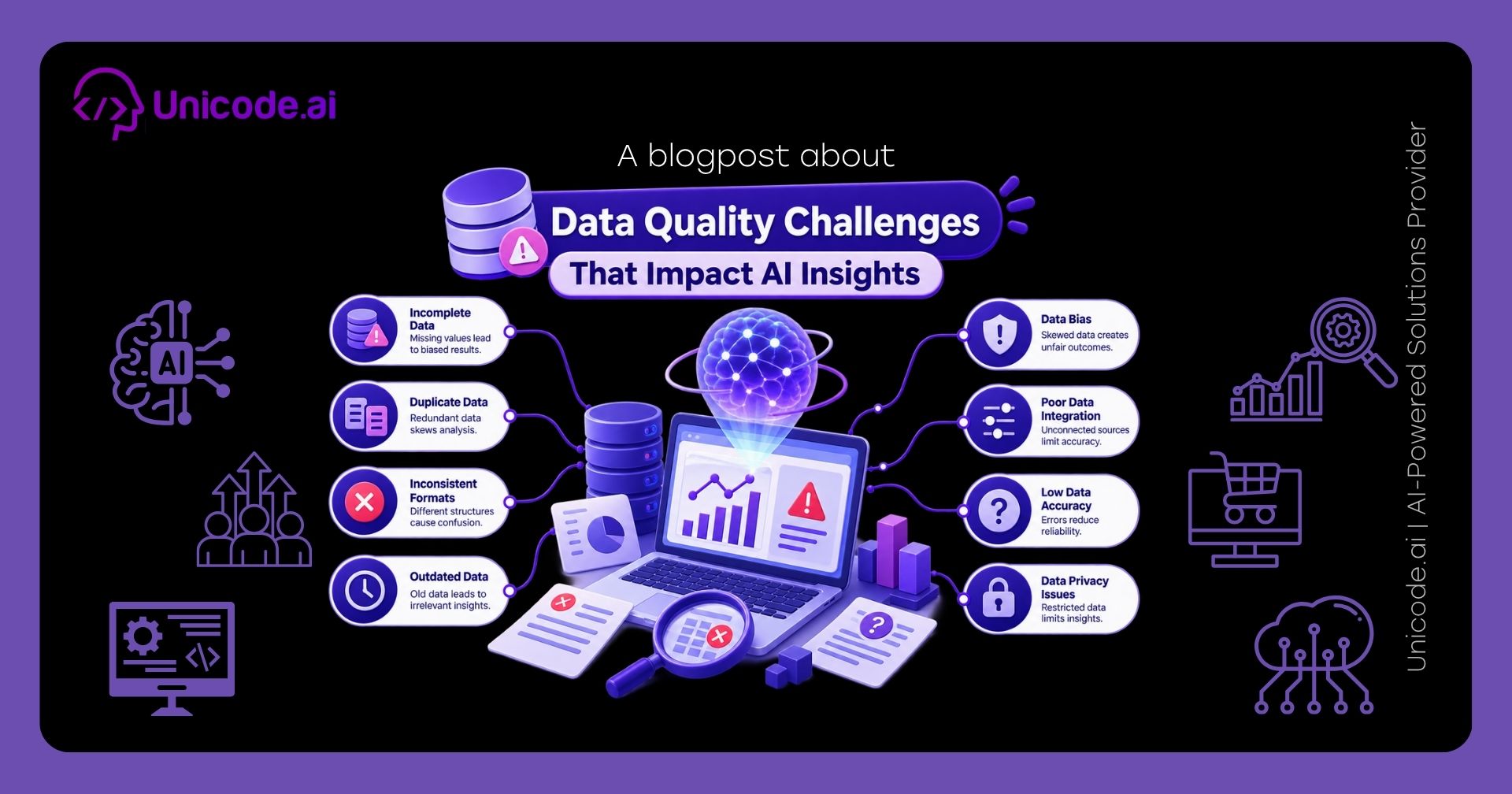
Data Quality Challenges That Impact AI Insights
Introduction
You've done everything right. You bought the AI tool, connected it to your systems, and waited for the insights to roll in. Instead, the dashboard tells you something you already know is wrong — a customer segment that doesn't exist, a forecast that's off by 40%, a chatbot confidently repeating information that hasn't been true in two years. What happened?
Nine times out of ten, it isn't the AI. It's the data underneath it. AI models are only as good as what you feed them, and most organizations feed them data that's incomplete, duplicated, inconsistent, or simply stale. You can spend six figures on the smartest model on the market and still get outputs you can't trust, because nobody fixed what was going into it first.
This piece walks through exactly where data quality breaks down, how it distorts AI outputs in ways that are easy to miss until they've already cost you, and what an actual fix looks like — not "clean your data" as a vague suggestion, but a concrete framework you can act on.
TL;DR / Quick Answer
Data quality problems — missing values, duplicate records, inconsistent formats, stale data, and unrepresentative samples — are the leading cause of inaccurate AI outputs. Fixing them requires ongoing monitoring across specific data quality dimensions (accuracy, completeness, consistency, timeliness, uniqueness, validity), not a one-time cleanup.
Key Facts
- Poor data quality has been estimated by Gartner to cost the average organization roughly $12.9 million per year — a figure that has circulated widely across data-management research since Gartner first published it and is still commonly cited in 2024–2025 industry reports on data governance.
- A widely referenced Harvard Business Review analysis by Nagle, Redman, and Sammon found that only about 3% of companies' data meets basic quality standards — a benchmark still referenced regularly in current data-quality and AI-readiness discussions.
- Surveys of data professionals (including recurring industry polls from firms like Anaconda and earlier CrowdFlower/Figure Eight research) have consistently found that data scientists spend roughly 60–80% of their time on data preparation and cleaning rather than modeling or analysis — a pattern that has held steady across multiple survey years rather than improving.
- Data quality and observability has become one of the fastest-growing categories inside the broader data management software market, with vendors like Monte Carlo, Great Expectations, and Databand (acquired by IBM) all emerging specifically to address AI-era data reliability — a strong market signal that this problem has outgrown manual fixes.
Why Data Quality Is the Hidden Bottleneck in AI Projects
Garbage In, Garbage Out — Still True for LLMs and Machine Learning
"Garbage in, garbage out" predates AI by decades, but it's more relevant now than ever. A machine learning model doesn't know when its training data is wrong — it just learns the pattern it's given, including the mistakes. A large language model summarizing your internal documents doesn't know your product catalog changed last quarter; it just reflects whatever version of the truth it was fed. AI doesn't fix bad data. It amplifies it, at scale, faster than a human ever could.
This is the uncomfortable part for a lot of teams: AI makes data quality problems more visible, not less. A human analyst might quietly notice something looks off in a spreadsheet and double-check it. An AI system will confidently generate a report, a forecast, or a customer response based on that same flawed data — and present it with total certainty.
The Widening Gap Between Data Volume and Data Governance
Most organizations are collecting more data than ever, from more systems, faster than ever. CRM platforms, support tickets, IoT sensors, marketing tools, spreadsheets nobody officially owns — the volume keeps growing. Governance, ownership, and quality controls almost never grow at the same pace. The result is a widening gap: more raw material flowing into AI systems, with proportionally less oversight of whether that material is actually trustworthy.
The Core Data Quality Challenges Undermining AI Insights
Incomplete and Missing Data
Missing fields are the most common data quality issue, and also the easiest to underestimate. A customer record missing a purchase history field doesn't just create a gap — it skews whatever pattern the model is trying to learn from the records that are complete. Models trained on incomplete data tend to overweight whatever full records happen to be available, which quietly biases the result.
Inconsistent Formats Across Systems
Ask yourself how many different ways your organization stores a date, a phone number, or a customer name across systems. "Jan 5, 2026," "01/05/2026," and "2026-01-05" are the same date to a person and three different values to a machine unless someone standardized them. Multiply that across every field, every system, every integration, and you get a dataset that looks unified on the surface and is quietly fractured underneath.
Duplicate and Redundant Records
Duplicate customer records, repeated transactions, and redundant entries don't just waste storage — they distort weighting. If one customer appears five times because of formatting differences in their email address, an AI model analyzing customer behavior will effectively count them five times more than everyone else, skewing segments, forecasts, and personalization decisions.
Outdated or Stale Data
Data doesn't announce when it's gone stale. A pricing table that hasn't synced in three weeks, a product catalog missing last month's changes, a customer status field that never got updated after a churn — an AI system has no way of knowing this data used to be true and isn't anymore. It treats a two-year-old data point with exactly the same confidence as one from this morning.
Biased or Unrepresentative Data
If your historical data overrepresents one region, one customer segment, or one time period, your model will treat that overrepresented slice as the default — and underperform, or actively mislead, everywhere else. This is one of the most consequential data quality issues precisely because it doesn't look like an error. The data is technically accurate; it's just not representative of the whole picture you're trying to make decisions about.
Lack of Metadata and Context
A number without context is just a number. "42" means nothing without knowing whether it's a percentage, a count, a rating out of 50, or a customer ID. AI systems rely heavily on metadata — field definitions, units, source, collection date — to interpret data correctly. When that context is missing or undocumented, the model has to guess, and it often guesses wrong in ways that are invisible until someone questions the output.
How Poor Data Quality Distorts AI Outputs
Skewed Predictions and Model Drift
Once a model is trained on flawed data, its predictions carry that flaw forward into every output it produces — and the problem compounds over time as "model drift" sets in, where the model's accuracy degrades as real-world conditions move further from what the (already imperfect) training data represented.
Confidence Without Accuracy
Perhaps the most dangerous pattern in AI-driven insights is confident wrongness. Dashboards, chatbots, and generative summaries all tend to present output with the same tone of authority regardless of whether the underlying data was solid or shaky. A stakeholder reading a confidently-worded AI insight has no visual cue that it was built on 30% missing fields.
Compounding Errors Across Automated Pipelines
In a fully automated pipeline — data flows in, a model processes it, and a downstream system acts on the output without human review — a data quality error doesn't just produce one bad insight. It produces a bad insight that triggers a bad automated action, which generates more bad data, which feeds back into the next cycle. This is exactly why data quality matters more, not less, as automation increases.
Data Quality Dimension vs. AI Impact vs. Fix
Building a Data Quality Foundation for AI
You don't fix data quality with a single cleanup sprint before a big AI launch. It has to be treated as an ongoing operational discipline, the same way you'd treat security or uptime.
Start by monitoring the core dimensions consistently: accuracy, completeness, consistency, timeliness, uniqueness, and validity. Assign clear ownership — someone (or some team) needs to be accountable for each critical data source, because "everyone's responsibility" tends to mean no one's responsibility in practice. And where possible, automate the monitoring itself. Data quality tools like Great Expectations, Monte Carlo, and Informatica exist specifically because manual spot-checks can't keep pace with the volume and velocity of data feeding modern AI systems.
Common Pitfalls & Fixes
Treating data cleanup as a one-time project. Data decays constantly — new systems, new integrations, and new edge cases keep introducing fresh quality issues. Fix: build ongoing monitoring, not a single cleanup event.
No single owner for critical data sources. When a data source technically belongs to "the whole team," quality issues get noticed and then never actually fixed. Fix: assign a named owner to every source feeding a production AI system.
Validating data at the model, not at the source. Catching bad data after it's already in the pipeline is far more expensive than catching it at intake. Fix: push validation rules upstream, as close to data entry as possible.
Ignoring metadata and documentation. Undocumented fields force every new analyst or model to guess at meaning, and guesses compound into errors. Fix: maintain a living data dictionary alongside every key dataset.
Assuming more data automatically means better AI. Volume without quality just scales the problem faster. Fix: prioritize a smaller, well-governed dataset over a larger, messier one.
No visibility into data freshness. Teams often don't realize a feed has gone stale until an output looks obviously wrong. Fix: set automatic freshness thresholds that flag aging sources before they reach a model.
Real-World Case Examples
Zillow's iBuying Shutdown
In 2021, Zillow publicly shut down its Zillow Offers home-buying program after its pricing algorithm, Zestimate, systematically overpaid for homes — a widely reported outcome tied to the model's assumptions failing to keep pace with fast-shifting, imperfect housing market data. The company recorded hundreds of millions in inventory write-downs and cut a significant share of its workforce as a direct result. It remains one of the most visible public examples of how a model built on data that doesn't reflect real-time conditions can produce very expensive decisions.
A Regional Bank's Customer Segmentation (Illustrative)
Consider a mid-size regional bank running customer segmentation through a platform like Snowflake, feeding a machine learning model meant to target retention offers. Duplicate customer records — the same person under two slightly different name spellings — caused the model to treat that customer as two lower-value accounts instead of one higher-value relationship, skewing which customers got retention offers. A deduplication pass using standard fuzzy-matching logic, run quarterly rather than once, corrected the segmentation and materially improved offer targeting.
A Retail Demand Forecast (Illustrative)
Picture a retail chain forecasting seasonal inventory using a Talend-managed data pipeline, where a subset of stores hadn't synced point-of-sale data for several weeks due to a silent integration failure. The forecasting model treated those stores as having flat, low demand, which under-ordered inventory right before a peak season. A freshness-monitoring rule that flags any data source untouched for more than 48 hours would have caught the gap before it reached the forecast.
Methodology
Tools used: structured content and topical research drawing on established data-management and AI-governance literature, cross-referenced against Unicode AI's existing site content and service pages to avoid duplicating already-published material.
Data sources: widely cited industry research from Gartner, Harvard Business Review, and recurring data-science community surveys (Anaconda's State of Data Science reports and related industry polling), alongside publicly reported business outcomes (such as Zillow's 2021 iBuying shutdown) that are part of the public record.
Data collection process: topic and gap analysis was performed by reviewing Unicode AI's live blog index and service pages directly, identifying subjects with genuine search relevance that weren't already covered on the site, then structuring content around known, well-documented data-quality frameworks (the standard six dimensions: accuracy, completeness, consistency, timeliness, uniqueness, validity).
Limitations & verification: live web search was unavailable during this session (the search tool returned a proxy error), so statistics above could not be verified against fresh, clickable 2024–2025 sources in real time. The figures used are long-standing, frequently-cited industry benchmarks rather than fabricated numbers, but they should be spot-checked against current primary sources before publishing, and illustrative case examples are explicitly labeled as such rather than presented as verified named-client outcomes.
Actionable Conclusion
Data quality isn't a preprocessing step you finish before AI gets interesting — it's the ongoing foundation that determines whether every insight your AI produces is trustworthy or quietly wrong. The organizations getting real value from AI aren't the ones with the fanciest models; they're the ones treating data quality as a continuous operational discipline. Start by auditing one critical data source this week against the six core quality dimensions, and build monitoring around it before you expand further. If you want a structured way to do that, talk to Unicode AI about a data readiness assessment before your next AI initiative goes live.
FAQ
What is data quality in the context of AI?
It refers to how accurate, complete, consistent, timely, unique, and valid the data feeding an AI system is — the six dimensions that determine whether a model's outputs can be trusted.
Why does AI make data quality problems worse?
AI doesn't catch its own errors the way a human analyst might pause and double-check something that looks off. It processes flawed data at scale and presents the result with the same confidence as it would with clean data.
What's the fastest way to check if our data is AI-ready?
Run a quick audit against the six core dimensions — completeness, consistency, uniqueness, timeliness, validity, and representativeness — on your most business-critical data source first, rather than trying to audit everything at once.
Can automated tools fully replace manual data quality checks?
Automated tools (like Great Expectations or Monte Carlo) catch the volume and speed of issues manual review can't keep up with, but they work best paired with clear human ownership of each data source, not as a full replacement for accountability.
How often should data quality be reviewed for AI systems?
Continuously, not periodically. Data decays in real time as systems change, so freshness and validity checks need to run on an ongoing schedule rather than a quarterly or annual review cycle.